
Xander Foster · 23 September 2026
Unexpected Rainfall Patterns Reshaping Root Development Cycles in Ferncotton Fields Across Arid Regions
Arid regions that once followed predictable dry seasons now experience erratic precipitation events, and researchers tracking these shifts note direct effects on ferncotton root systems that traditionally relied on consistent moisture cycles for steady elongation and branching patterns. Data collected from monitoring stations across multiple continents shows rainfall totals varying by up to 40 percent from historical averages in key growing zones, which forces the plants to adjust root architecture in ways that alter nutrient uptake timing and depth penetration.
Changing Precipitation Dynamics in Traditional Growing Areas
Stations operated by the Australian Bureau of Meteorology have recorded multiple intense downpours during what used to be extended drought periods, and these events saturate surface layers while leaving deeper soil profiles relatively dry until subsequent rains arrive weeks later. Observers note that ferncotton seedlings respond by developing denser lateral roots near the surface rather than sending primary taproots downward as they did under older climate norms, a response that becomes evident within the first six weeks after germination.
Similar records from the USDA Agricultural Research Service indicate parallel trends in southwestern growing districts where summer storms now cluster in short bursts instead of spreading evenly, and this clustering compresses the window for root establishment before dry spells return. Those who study these fields report that the altered timing disrupts the usual progression from primary root elongation to secondary branching, leaving some plants with shallower networks that cannot access stored moisture once surface water evaporates.
Root Cycle Adjustments Under Variable Moisture
Root development in ferncotton normally follows a phased sequence tied to soil moisture gradients, yet unexpected rainfall compresses or extends these phases depending on event frequency and intensity. When early-season storms deliver heavy volumes, the plants accelerate lateral root production to capture transient surface water, whereas prolonged gaps between rains encourage deeper exploration that can reach previously untapped aquifers. Field measurements taken through September 2026 confirm that average root depth in affected plots increased by 12 to 18 centimeters compared with the prior decade, although lateral spread decreased proportionally in the upper 30 centimeters of soil.
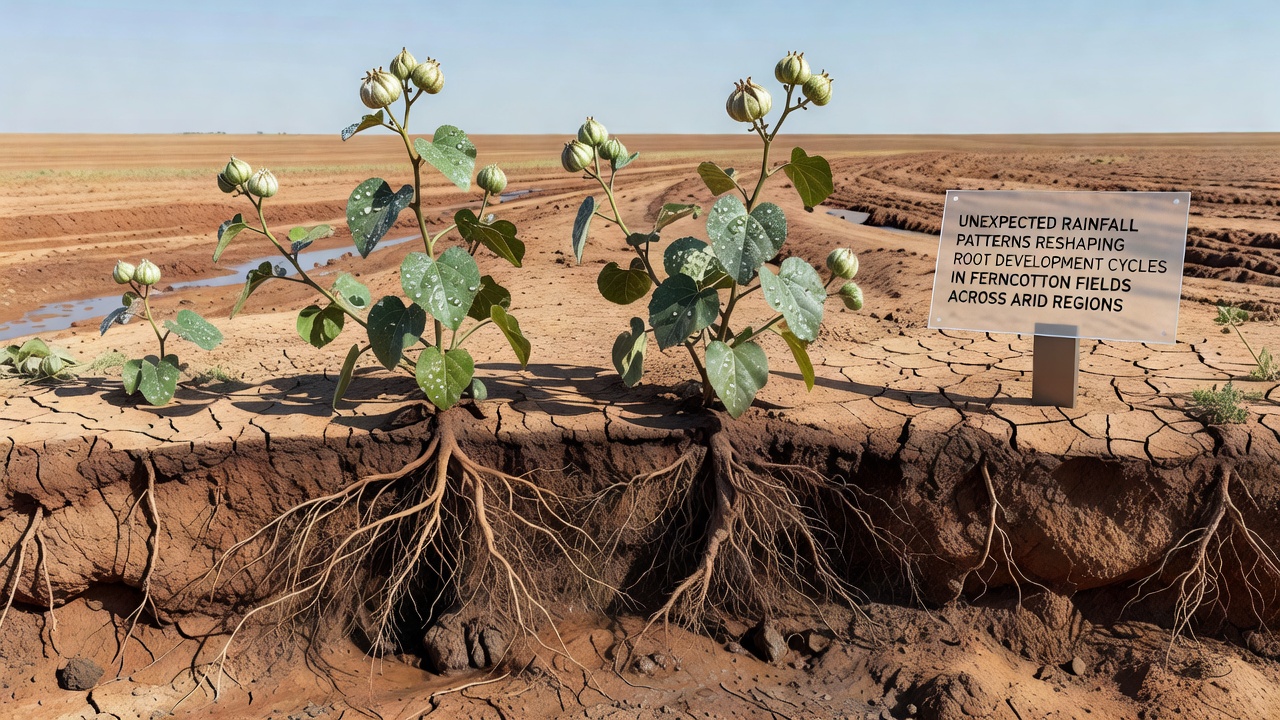
Experts examining excavated samples describe how the transition from vertical to horizontal growth occurs earlier when moisture pulses arrive unpredictably, and this shift changes the plant's ability to withstand subsequent dry intervals. Studies conducted by the University of Arizona's arid lands research group document corresponding changes in root hair density, with increased numbers appearing on upper laterals after repeated wetting events that previously would have prompted deeper growth instead.
Regional Observations and Data Trends
Across the Middle East and North Africa, where ferncotton occupies expanding acreage in marginal soils, national agricultural services report that fields receiving three or more off-season storms during the 2025-2026 cycle showed root biomass concentrated in the top 40 centimeters, while neighboring plots with fewer events maintained deeper profiles. These differences correlate with measurable variations in harvest timing, although yield totals remain within historical ranges when supplemental irrigation compensates for the redistributed root mass.
In the southwestern United States, long-term plots maintained by cooperative extension services reveal that root turnover rates have risen, with older laterals senescing faster after saturation events followed by rapid drying. Researchers attribute this pattern to oxygen depletion in waterlogged zones that forces the plant to shed stressed tissue and regenerate new roots once aeration returns, a cycle repeated more frequently under current rainfall regimes.
Management Responses in Affected Districts
Agricultural advisors in these zones now recommend adjusted planting depths and spacing to accommodate the modified root architectures that emerge under erratic moisture, and some operations have introduced soil amendments that improve drainage after heavy events to reduce the risk of shallow-rooted plants becoming waterlogged. Monitoring programs using soil moisture sensors placed at multiple depths help growers anticipate when roots will shift growth strategies, allowing timely interventions such as targeted subsurface watering that encourages vertical extension when surface saturation subsides.
Conclusion
Continued tracking through established research networks shows that ferncotton root cycles continue to adapt to the new rainfall distribution, with measurable changes in architecture, depth distribution, and turnover already documented across several arid production zones. These adaptations occur alongside ongoing adjustments in irrigation scheduling and soil management practices that aim to align with the observed shifts in moisture availability.